
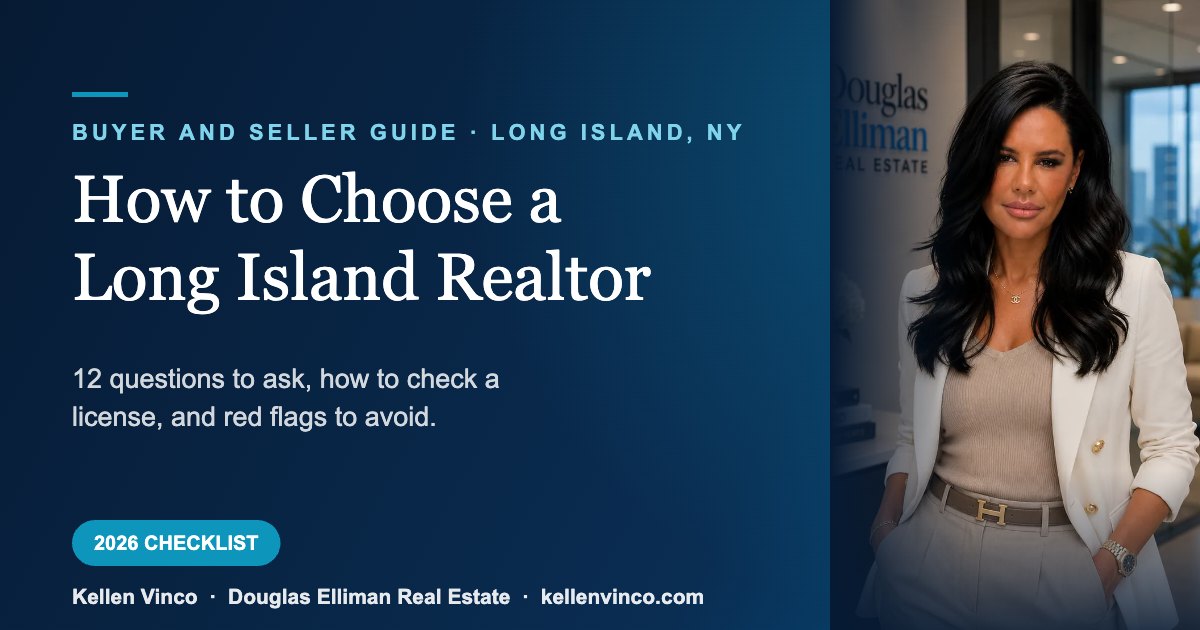
Knowing how to choose a Long Island realtor can save you thousands of dollars and months of stress. Long Island is not one market. Property taxes, school districts, flood zones, and commutes can change from one street to the next, so the agent you pick matters.
This guide gives you a simple way to compare agents in Nassau and Suffolk counties: what to check, the 12 questions to ask, and the red flags to watch for.
Pick a licensed agent who knows the exact towns you want, explains the Long Island costs clearly, answers fast, and puts the plan and the pay in writing before you tour. Check the license on the New York Department of State website, ask at least 12 questions in an interview, and choose the person whose answers are specific, not salesy.
What is the difference between a realtor and a real estate agent?
A real estate agent is anyone licensed by New York State to help people buy, sell, or rent. A REALTOR® is a licensed agent who is also a member of the National Association of REALTORS® and agrees to follow its Code of Ethics. On Long Island, most REALTORS® also belong to the Long Island Board of REALTORS®.
Both must follow New York law. The title alone doesn't make someone better at the job, so use the questions below to judge the person.
How do I check a real estate agent's license in New York?
You can check any agent's license for free with the New York Department of State licensee search. Type in the agent's name and confirm three things:
- The license is active.
- The license type (salesperson or broker).
- The brokerage the agent works under.
It takes two minutes and it's the first thing you should do.
What forms will a Long Island agent ask me to sign?
In New York, agents must give you a few forms early on. None of them lock you into a purchase, but read each one.
- Agency disclosure form. New York law requires agents to explain who they work for, using the New York State Disclosure Form for Buyer and Seller under Real Property Law section 443.
- Housing and anti-discrimination form. New York also requires the Housing and Anti-Discrimination Disclosure Form, which explains your fair housing rights.
- Written buyer agreement. Since August 17, 2024, agents who are MLS participants must sign a written agreement with a buyer before touring homes, under NAR practice changes. The agreement must state how the agent gets paid, and that pay is negotiable.
Here's what that actually means for you: before your first showing, you should know exactly what your agent will do and how they get paid. If it's not in writing, ask.
12 questions to ask before you hire a Long Island realtor
Interview at least two agents. Good answers are specific, local, and honest. Vague answers are a warning sign.
- Which towns do you work in most? You want someone who knows your towns, not all of Long Island in general.
- How do you check property taxes and school districts for a specific address? On Long Island these can change street by street.
- How fast do you reply to calls and texts? In a busy market, a slow reply can cost you the house.
- What will our written agreement say, and how are you paid? Ask for it in plain words before you sign.
- How do you decide what to offer? Look for an answer based on recent nearby sales, not a guess.
- Who else will I work with? Ask about lenders, attorneys, and inspectors, and whether you can choose your own.
- How do you explain New York closing costs? A good agent can walk you through the mortgage tax, attorney fees, and title costs.
- What happens after the offer is accepted? On Long Island, attorneys handle the contract, so ask how the agent keeps things moving.
- Do you speak my language? If you're more comfortable in Spanish or another language, ask for an agent who can explain every form in it.
- Have you helped buyers like me? First-time buyers, ITIN buyers, sellers who need to buy at the same time, or investors all need different plans.
- What mistakes do you see buyers or sellers make here? Honest agents share real examples.
- Can I end the agreement if it's not working? Know the terms before you sign.
What should a seller ask a listing agent?
Sellers should ask the same basic questions, plus these:
- How did you arrive at the price you suggest? Ask to see the comparable sales.
- What will you do to market my home online and in person?
- What should I fix, and what should I leave alone?
- How will you keep me updated each week?
If you want to see how pricing works first, read how much is my Long Island home worth.
What are red flags when choosing an agent?
- They promise a sale price or a win without seeing the numbers.
- They push you to sign before explaining the agreement.
- They can't tell you the tax or school district for a home they're showing.
- They describe neighborhoods by the kind of people who live there. That can break fair housing rules.
- They go quiet for days at a time.
Why local knowledge matters so much on Long Island
Long Island has 2 counties, dozens of towns and villages, and many school districts. Two homes a mile apart can have very different tax bills, commutes, and flood risk. A local realtor helps you compare the true monthly cost, not just the list price. Read the Long Island property tax guide to see why.
Why buyers and sellers work with Kellen Vinco
I'm Kellen Vinco, a licensed real estate salesperson and REALTOR® with Douglas Elliman in Smithtown, licensed since 2001. I spent 25+ years in commercial property management before selling homes, so I read tax bills, repair estimates, and contracts closely. I work in English and Spanish across Kings Park, Commack, Huntington, Fort Salonga, Dix Hills, Smithtown, Hauppauge, and Hicksville.
I don't rush deals. I focus on clarity, strategy, and protecting your time and money. If you're buying for the first time, start with the first-time buyer programs guide. When you're ready, book a free consultation and interview me with these 12 questions.
Sources and helpful links
- NY Department of State: Licensee search
- NY Disclosure Form for Buyer and Seller (DOS-1736)
- NY Real Property Law section 443
- NY Housing and Anti-Discrimination Disclosure Form
- NAR: Consumer guide to written agreements
- NAR: What the settlement means for buyers and sellers
- Long Island Board of REALTORS: Public license search

Kellen helps Long Island buyers and sellers in English and Spanish, with 25+ years of property management experience behind every home she walks through.
This article is for general information only and is not legal, tax, mortgage, or financial advice. Market conditions change, so confirm details for a specific property. Equal Housing Opportunity.
Want the step-by-step buyer checklist?
Use Kellen’s buyer guide to organize your budget, lender questions, neighborhood priorities, property taxes, and next steps before touring homes on Long Island.
- ✓ First-time buyer planning checklist
- ✓ Budget, closing cost, property tax, and pre-approval reminders
- ✓ Helpful for relocation, ITIN, and Spanish-speaking buyers
Download the Buyer Guide
Submit the form and you’ll see an immediate confirmation on the page. Your guide link will appear after a successful submission.
This guide is informational and not mortgage, tax, legal, or financial advice. For property-specific questions, speak with the appropriate licensed professional.
Common questions
How do I find a good realtor on Long Island?
Interview at least two licensed agents who work in your exact towns. Check each license on the New York Department of State website and ask how they handle taxes, offers, and closing costs.
Is a realtor the same as a real estate agent?
Not exactly. Every REALTOR is a licensed agent, but a REALTOR is also a member of the National Association of REALTORS and follows its Code of Ethics.
Do I have to sign an agreement with a buyer's agent?
Yes, in most cases. Since August 17, 2024, MLS participants must have a written agreement with a buyer before touring a home. It must state the agent's pay, which is negotiable.
How do I check an agent's license in New York?
Use the free licensee search on the New York Department of State website. Confirm the license is active and see which brokerage the agent works under.
Can I work with a Long Island realtor in Spanish?
Yes. Some Long Island agents are bilingual. Kellen Vinco works in English and Spanish and explains every form in the language you prefer.
Want to interview me with these 12 questions?
Get clear, honest answers about your budget, timing, and options, in English or Spanish. No pressure.
Book a Free Consultation